

 fsadmlgn
Friday, June 5, 2020, was an eventful day in Kansas City, Mo.
That day, officials at Pembroke Hill School–the most elite prep school in town and a member of the National Association of Independent Schools–received guidance from Donna Orem, president of the National Association of Independent Schools, about how to respond to the death of George Floyd.

In the memo, “Building More Equitable and Just Communities,” she referred to “communities reeling from trauma, despair, and anger” and said private schools needed to “take real action to create physical and psychological safety for vulnerable children, youth, and adults.”
On campus, the head of school, Brad Shelley, sent a letter to the Pembroke community about “the tragic deaths of Ahmaud Arbery, Breonna Taylor and George Floyd along with the subsequent violence during protests in many cities, including our own.”

Less than a mile away from the Pembroke Hill campus, Rodney D. Smith was an adjunct professor of “racial and ethnic diversity” topics at the School of Education at the University of Missouri-Kansas City. That day, he and his wife, Stephenie Smith, promoted their “diversity, equity and inclusion” consulting business, Sophic Solutions LLC, on a podcast, “American Public Square at Jewell.”

The “Both Sides” segment was called “Sophic Solution’s [sic] Cofounders on Systemic Racism.” William Jewell College is located about 20 miles northeast of Kansas City in Liberty, Mo.
In their podcast, the Smiths prescribed some action steps for schools, with Ms. Smith saying schools need to “look for inequity…in pedagogies, policies, practices, and people” and that Sophic Solutions provided these “change management” services to clients.
One of their next customers was not far away: Pembroke Hill School.
In the wake of the killing of George Floyd on May 25, 2020, many private schools–not just the elite New York City prep schools that have made the news– made massive modifications to their curriculum and pedagogy. Pembroke Hill School is one of them, and its journey into activism is a cautionary tale of what happens when equity–rather than excellence–becomes the priority.
In just one year, Pembroke Hill moved away from its identity as a college prep school to offering identity-based English classes studying novels by 1619-Project authors and critical theories from a grad school textbook and the Smiths–as outside consultants–played an active role in that change. It turns out it is activists, not parents, that are telling private schools what they should teach, much as they are doing with public schools. Pembroke didn’t respond to a query seeking comment.
Meet the Smiths
Rodney and Stephenie Smith, the husband-and-wife owners of Sophic Solutions, a Kansas City-based consultancy, registered their company with the Missouri Secretary of State in 2016, according to their business filing, though Ms. Smith’s LinkedIn profile and Mr. Smith’s LinkedIn profile list the start of their business much earlier.

Either way, their work was steeped in activism, the banner on Mr. Smith’s LinkedIn profile reading, “Black Lives Matter.” After an initial email exchange, Sophic Solutions did not respond to the request to comment on their work.
According to his LinkedIn profile, Mr. Smith is a graduate of Morris Brown College in Atlanta, one of the nation’s historically black colleges and universities, or HBCUs. (Incidentally, the college had been unaccredited for the last 20 years due to financial mismanagement and a 2002 embezzlement scandal, but was reaccredited in April 2021.) He also holds a doctorate in education in administration and supervision from Tennessee State University, another HBCU, located in Nashville.
Two months after the podcast episode aired, Jewell College named Mr. Smith vice president for access and engagement, in charge of “recruitment and retention of students, faculty and staff of color and other marginalized backgrounds.” He is the author of the 2016 book Are We Just Crabs in a Barrel, about the “Black gaze.” And he wrote a chapter titled, “I Cried,” in the 2015 book, The Trayvon Martin in US. According to her LinkedIn profile, Ms. Smith is a “community change agent” with a B.A. in psychology from Fisk University–another HBCU school–also in Nashville and an M.S. in social work from the University of Tennessee in Knoxville, Tenn.
During the “Both Sides” podcast, the Smiths introduced themselves and their business. A few clicks on the company’s website includes a list of their business services, such as “educational consultation to schools and school districts,” “diversity, equity & inclusion training,” “educational curriculum” and “professional development sessions.” The website’s “Where We Stand” statement on its homepage encourages “community members to join us” to “vote for people, policies, and practices that support equity” and “always ask, ‘what are the identity implications?’ when making decisions.”
The company’s client list includes businesses, colleges, universities and K-12 schools and school districts, including the nearby Platte County R-3 School District in Platte City, Mo., a town about 25 miles north of Kansas City.
Next, the podcast discussion shifted to defining terms, such as “DEIB,” or “Diversity, Equity, Inclusion and Belonging.” In defining “diversity,” Mr. Smith explained that people “need to do a better job at diversifying power roles,” and Ms. Smith said that “equity” requires recognizing “that there’s a need to redistribute power and to change structures.”
She said that “belongingness” is “about what does it take.”
As the Smiths discussed the George Floyd protests taking place in the early summer of 2020, Mr. Smith said, “obviously, we have an appreciation for agitation.” Ms. Smith said, “most of you are more concerned with the buildings being burned down than what caused the buildings to be burned down.” Interestingly, the topic of “educational curriculum,” one of the services the Smiths touted on their website, didn’t come up.
But a critique of capitalism did, an ironic concept for consultants to an elite private school.
‘Dismantle…capitalism’
Ms. Smith said, “This is part of capitalism. This is part of the water that we swim in. There is a whole group that exists to have less. Because their existence creates a platform for others to have more, a specific group of others to have more…and that’s why the struggle has been 400 years.” She continued:
“That is why racism is a major tool to perpetuate capitalism. Race needed to happen so that capitalism could thrive because there needed to be a group that existed to have less, so that those that were less could create more for the others. So, when we really think about the examination that it takes to really dismantle a system that is steeped in capitalism which leverages racism to do the work, then we’re talking about this dismantling.”
In talking about the need to “dismantle a system,” the Smiths spoke about May 30, 2020, protests that had just occurred in Kansas City’s Country Club Plaza shopping mall–just a half mile north of Pembroke’s lower school campus. The protests had turned violent and destructive and led to over 50 arrests.
In his June 5, 2020, letter, Pembroke’s head of school also referred to the protests, writing, “Because we live just up the street from the Plaza, I have witnessed our community struggle to come to terms with these horrific events while trying desperately to affect change that will ensure a safer and more just world for all, not just those with privilege.”
The letter included a mention of the school’s theme for the year: “Building Together, will be our guiding light.” The school had certainly built an empire since its founding in 1984. According to Pembroke’s 2019 IRS 990, the school had $146 million in assets as of June 30, 2020.
The school–with an original mission to promote classic liberal education–was created when the all-girls Sunset Hill School (founded in 1913) and the all-boys Pembroke-Country Day School (founded in 1910) merged.
But by June 2020, the focus of leaders had shifted away from classic liberal education.
By the end of the month, Pembroke Hill had hired Sophic Solutions to provide consultation services to the school. Since Pembroke is a private school, the consultant contract isn’t a matter of public record. However, the Platte County School District, just north of Kansas City, also hired Sophic Solutions for similar work and its contract offers a window into the kind of services Sophic Solutions provides.
‘The work’
At its Feb. 20, 2020 meeting, the Platte County School Board unanimously approved (7-0) Sophic Solutions’ “Consulting Proposal: An Equity-Centered Approach,” costing $27,500. The cost included: five hours of consulting per month at $300 per hour, or $1,500 per month and $18,000 total; facilitation of four two-hour workshops at $1,000 per hour, or $8,000 total, and a final report for $1,500. Additional consulting hours would be billed at $300 per hour.
The workshop series promised, “Participants will be afforded the opportunity to engage in real introspection and critical reflection.” The contract said, “Participants will explore the fluidity and ubiquity of many of the ‘isms’ that permeate our society.”
A few days later, on Sunday night, Feb. 23, 2020, at 8:55 p.m., Ms. Smith wrote to school district official Vicki Diggs, “Looking forward to serving together,” according to a copy of emails that Parents Defending Education received in response to a public records request.
That summer, Mike Brown, a white assistant superintendent in the Platte County School District, wrote to the Smiths and thanked them for checking in on him. He confessed, “I really appreciate it. Been rough here for the old guy lately but I will come out of it. Being an extremely reflective person, I always seem to find my way. I have to as I have a lot of people counting on me.”
He continued: “Good session today! Thank you for your leadership!”
He later apologized for spelling Ms. Smith’s name “Stephanie,” instead of “Stephenie,” as she spelled it.
She responded, “Glad you are doing the work to better understand yourself and those around you.”
A few days later, the school district superintendent, Mike Reik, also white, emailed the Smiths, asking if they minded if he shared an advertisement for another consultant, La’Wana Harris, author of Diversity Beyond Lip Service, and Angela Knudsen, a local consultant. The advertisement read, “Current tragic events remind us constantly that injustice and inequality exist,” and urged embarking on a “journey to becoming a more thoughtful and effective ally for advancing meaningful diversity, equity and inclusion.”
As they continued “the work,” that fall 2020, Ms. Smith wrote a school district official, “Pray each of you are navigating this unique time in history with grace and equity, as best you can.”
Indeed, “the work” continued. In January 2022, Platte County School District paid Sophic Solutions $1,500 for December 2021 “equity and inclusion consultation.” In all, the school district has paid $30,800 to Sophic Solutions.
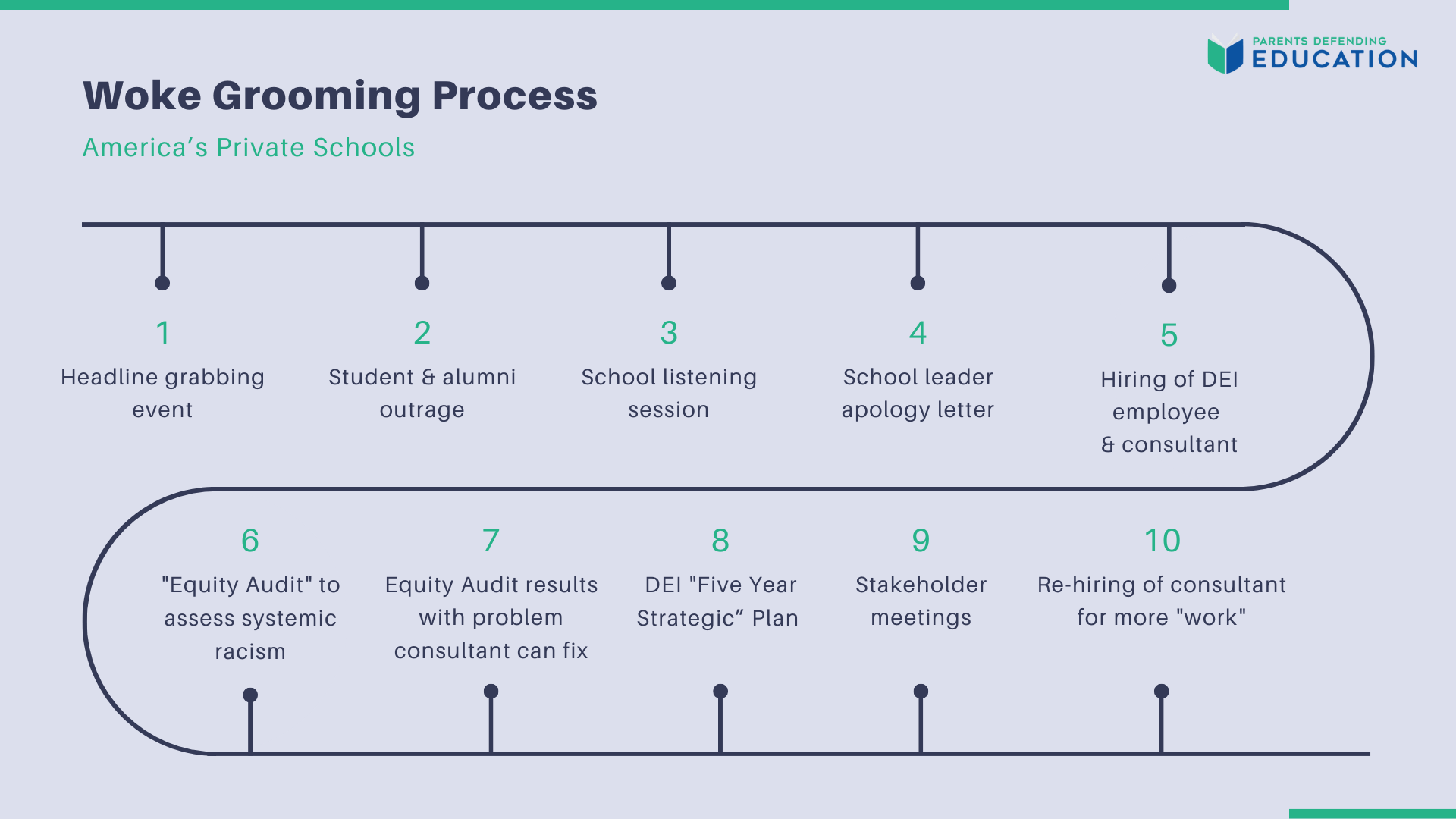
The ‘fear zone’
Back at Pembroke Hill, the Smiths and school administrators stayed busy as Black Lives Matter protests erupted around the country in the summer of 2020. In a June 23, 2020 letter, Brad Shelley told Pembroke families to “acknowledge the existence of systemic racism both in our country and in our school” and to expect “purposeful and sustainable change in our [school’s] culture, policies, procedures and curriculum.”
On Aug. 13, the Smiths hosted two “All-Community Conversations.” In a slide deck for the sessions, the Smiths described themselves as “change agents and community mobilizers.”
According to a copy of the slide deck, they encouraged “being uncomfortable,” linked “equity” with criminal justice reform and framed U.S. history through the lens of the controversial “1619 Project.” They defined “anti-racism” as “redistributing power” and explained that “denying racism is a problem” considered the “fear zone.” They urged Pembroke to move from “diversity” to “belonging,” “inclusion” and then finally “equity,” defined as “changing structures of power and privilege so disparities of historically underrepresented groups are eliminated and therefore outcomes cannot be predicted by that grouping.”
The Smiths explained a “white supremacy” pyramid and “the dangers of the ‘I don’t see color’ mentality.” The U.S. history infographic in their slide deck started with the year 1619 and divided U.S. history into three periods: American “chattel slavery,” “segregation” and “current era.” The Smiths recommended that the Pembroke community read about the history of Kansas City from the perspective of self-described activist, atheist and socialist writer G.S. Griffin and ginned up guilt for the economic disparities of Kansas City–inequities that could be remedied by changes they would be recommending at the school.
Privately, some parents questioned Sophic Solutions’ claims and conclusions. But school officials continued forward, noting their “progress” on the school website. In September 2020, the consultants hosted the inaugural meeting of the “DEI Advisory Council.” Then, Sophic Solutions conducted “DEI Assessment Conversations” in October 2020 and led “Stop, Start, Continue and Consider” discussions in December 2020.
That month, Pembroke sent three adults and six students to a virtual meeting of the National Association of Independent Schools “People of Color Conference” and “Student Diversity Leadership Conference,” according to the school’s website. The following month, in January 2021, the Pembroke “DEI team” created the new position of “Director of Diversity, Equity & Inclusion” reporting to the head of school, according to the school’s website and organizational chart.
‘Hold on for a long list’
On Feb 1, 2021 at the school’s virtual parent council meeting, parents learned that the changes weren’t confined to consultant “conversations,” or DEI Advisory Council “meetings” or NAIS “conferences” but had come into the classroom.
During the meeting, upper school English teacher Jermaine Thompson explained that the English department was:
“very committed to introducing students to various lenses of critical theory” including “prison lit,” “eco-criticism,” “postcolonialism,” “immigrant literature” and “feminist criticism.”
Thompson began teaching at Pembroke in August 2019. Upon his suggestion, the “entire English department” attended Robin DiAngelo’s October 2019 White Fragility book lecture at the University of Missouri-Kansas City to “interrogate our own attachments to whiteness as a destructive power structure.”

During the Q&A portion of the parent council meeting, one parent typed a question into the chat, “Has the English department read and or considered teaching ‘The Content of Our Character’ and ‘Human Diversity’ and which critical theories do you teach?”
Thompson replied, “I don’t think we’ve talked about those two specifically, but I will definitely add them to our list of possibilities. And as far as critical theories goes, well hold on for a long list. So, in my class this year we have covered lenses such as mentalism…womanism, feminism and postcolonial lenses.” He continued:
“So whatever critical theories that are listed in that book we’re all given as grad students, we spend some time on each one of those.”
‘The whole color-blind thing’
On Feb. 3 2021, Pembroke suspended a 25-year-veteran math teacher, Beth Reams, allegedly for a social media post she had made back in August 2020, criticizing COVID mandates. The post read that “the horrific truth is … if people were told to get into boxcars to be taken to ‘virus protection camps’ many of them would rush to get in line.” The suspension came two days after a local Kansas City newspaper reported that a Pembroke student had drawn a swastika on a desk in a different classroom.
When the upper school head, Mike Hill, met with Reams on Feb. 18, 2021, to discuss her social media post, he scolded her for not “seeing the color” of her students, according to a transcript from a recording of the meeting.
Mr. Hill said, “If I asked you today which of your students were Jewish, you probably couldn’t tell us … One of my concerns is that you don’t have that information … What I believe we’re trying to do … is create a division and be a part of a school where not only inclusivity is important, but also awareness…”
Ms. Reams replied, “I hear you. I just think that it’s very difficult, especially in math, to get to know a lot of things about the kids, and I think religion should not come up in our math class … I think where it becomes important for me to understand [who is Jewish] is when I do see an absence for a Jewish holiday … Then, of course, it would come on my radar. I think especially, this year in particular, every teacher would agree it’s been a lot harder to get to know our students … I think it’s important that when my kids walk in the room, I’m judging them on their math.”
Then Mr. Hill said, “Do you know which [students] are Latino?”
Ms. Reams, who is white, replied: “I couldn’t sit here and label my kids.”
Mr. Hill, who is black, persisted, “Do you know which ones are East Asian? … The whole colorblind thing … is driving me crazy. Because I think it’s very dangerous.”
Later that month, according to the school’s website, faculty and staff participated in a required professional development training in “diversity, equity and inclusion,” led by Sophic Solutions and Jewish Community Relations Bureau/AJC, an organization based in nearby Overland Park, Ks., that leads anti-semitism training.
In March 2021, Sophic Solutions presented an assessment to the Pembroke board, and Pembroke’s head of school told the suspended math teacher that her teaching contract would “not be renewed.” In April 2021, school officials hosted multiple anti-semitism sessions, and Sophic Solutions led another “Start, Stop, Continue and Consider” session.
Institutional change
By May 2021, Pembroke announced that Jason Gines–a 1995 graduate of Pembroke–would be the school’s first “diversity, equity and inclusion” director, starting in the 2021-2022 school year.
Mr. Gines holds a Ph.D. in counselor education and supervision from Penn State University, where he studied efforts to return the incarcerated back into society, according to an interview he conducted at Pembroke. Most recently, he worked as an assistant dean in Penn State’s Office of Inclusion and Diversity Engagement.
In June 2021, the Diversity, Equity and Inclusion Advisory Council presented its recommendations to the board of trustees, and in July 2021, Gines joined the Pembroke staff. Also that month, the school partnered with School Smart KC, a Kansas City-based education advocacy group, for the second “Equity in Schools Cohort with Beloved Community,” a New Orleans-based activist organization.
Beloved Community’s website says: “When we question and challenge the default, we can dismantle it and build equitable systems in its place.” The organization recommends “racial identity caucuses: one for white staff, one for Black staff, and one for non-Black People of Color.” Critics allege this segregation is a violation of the U.S. Civil Rights Act of 1964.

In August 2021, students returned to school, and Pembroke published new student, faculty and staff statistics, crowing: “37% of our new students identify as BIPOC,” the acronym for “Black, Indigenous, People of Color,” and “27% of our new faculty and staff identify as BIPOC.” According to the school’s new diversity recruiting statement, school “applicants must be committed to and passionate about diversity, equity and inclusion to contribute to academic success with inclusive excellence.” Pembroke posts job openings through the NAIS Career Center.
The new school year brought more community conversations and diversity, equity and inclusion-based professional development, as well as new curriculum infused with the new “diversity” mantra. The critical theories taking over the upper grades was filtering down to middle grades as well. For example, according to the school website, Pembroke’s new English class for eighth graders “centers around issues of identity, diversity, inclusion and equity.”
In fall 2021, students in the class studied a novel, Piecing Me Together, by Renee Watson, co-author with Nikole Hannah-Jones of a book, The 1619 Project: Born on the Water. Piecing Me Together is recommended by “Teaching for Change,” an activist organization affiliated with the Black Lives Matter At School organization and the Howard Zinn Trust, which promotes the work of controversial historian Howard Zinn. The school’s “Anti-Racism Resource List” includes Antiracist Baby by author Ibram X. Kendi and White Fragility by author Robin DiAngelo.
Parents were starting to wonder if these changes had anything to do with education or were more focused on activism. In January 2022, concerned parents founded Pembroke Hill Parents & Alumni Defending Education, a constituency to push back against the radicalization taking place in Pembroke Hill School’s classrooms.

The national fight
Government officials were also starting to ask questions about radicalization in classrooms in the state. In July 2021, Missouri Governor Mike Parson said on Facebook, “Critical Race Theory (CRT) has no business being taught in Missouri classrooms.” By November 2021, Missouri Attorney General Eric Schmitt filed suit against Springfield Public Schools in Springfield, Missouri, for Sunshine Law violations after requesting documents on critical race theory in schools and getting railroaded.
The scrutiny came amid a wider national debate. In late 2021, during the Virginia governor’s race, Democratic gubernatorial candidate Terry McAuliffe said, “I don’t think parents should be telling schools what they should teach.” On “Meet the Press” on Dec. 26, 2021, New York Times Magazine writer Nicole Hannah-Jones, author of the “1619 Project,” told host Chuck Todd she didn’t “really understand this idea that parents should decide what’s being taught.”
The first week of January 2022, Missouri lawmakers returned to the state capitol building in Jefferson City. Stopping the teaching of critical race theory in public K-12 classrooms was on the agenda. On Feb. 15, 2022, the Missouri House Elementary and Secondary Education committee passed House Bills Nos. 1995 & 1474, known as the Parents’ Bill of Rights for Student Well-Being, to protect students from critical race theory, provide curriculum transparency and protect parental rights.
But institutions like Pembroke were below the radar–away from scrutiny because their status as an “independent school” gave them cover from the reach of public records laws and lawmakers. Experts claim “critical race theory is not taught in public schools and remains a complex law school and graduate school subject well beyond the scope of a K-12 class.” Meanwhile, Pembroke brags about teaching every critical theory listed “in that book we’re all given as a grad students.”
The National Association of Independent Schools, which represents private schools including Pembroke, told its member schools what to teach about George Floyd’s killing. During their national 2021 conference, speakers told school officials to learn about “Small Activists, Big Impact: Cultivating Anti-Racists and Activists in Kindergarten,” and dozens of other race, class and gender topics. And schools hired accreditors, consultants and diversity, equity and inclusion administrators from the wokeindustrial complex to tell them what to teach.
Parents with whom we’ve spoken don’t want their children indoctrinated in lessons about “dismantling” capitalism, as the founders of Sophic Solutions preached or the critical theories that have captured the Pembroke Hill School English department. Most want academics, not activism. And they are wondering why trustees, alumni, faculty and administrators are blindly letting consultants, radical teachers and so-called “experts” tell schools what to teach, how to teach and whom to hire. Could private schools’ sensitivity to their “elitist” label be making them vulnerable to falling for virtue signaling? And why do the loudest voices calling private schools “elitist” happen to be those most opposed to an idea that would bring true economic diversity to private schools: school choice?
Concerned parents, alumni, donors and faculty are staring to join with local groups and national organizations to encourage schools to use their “broad authority to dismiss,” in the words of enrollment contracts, the undue influence of organizations such as the National Association of Independent Schools and consultants in the woke-industrial complex, like Sophic Solutions. Their services are not education but rather indoctrination.
Alternative associations exist and many schools choose to not belong to a schools’ association at all. And some donors realize conserving quality education sometimes means building new schools: supporting diversity in institutions beats supporting so-called “diversity and inclusion.” Academic excellence, accountability, transparency and school choice for American families is a key piece of the parents’ movement of 2022–from public schools across the country to Pembroke Hill School in Kansas City, Mo.

